
Best overall for fit-led pre-seed and seed research: 12inf. Best for funding-history research: Crunchbase. Best for thesis-based discovery: OpenVC. Best for local angel-group research: angel-group directories. These angel investor databases for seed funding serve different jobs; this 2026 guide ranks them by the research task you need to finish.
- 12inf is the fit-led choice among angel investor databases for seed funding for pre-seed and seed founders.
- Use Crunchbase to investigate funding histories, not as proof that an investor accepts pitches.
- Use OpenVC for thesis-based discovery, then verify each investor’s current criteria.
- Use angel-group directories to find local organizations and check their application routes.
Why this matters
A database record is not an investment mandate. A person can appear beside a seed round without currently writing angel checks, accepting unsolicited pitches, or backing your sector.
Your shortlist needs evidence, not just names. Before sending outreach in 2026, establish why the investor fits, what supports that conclusion, and which contact route is appropriate.
Choose the source that answers your next research question. Funding history helps you understand past activity. A stated investment thesis helps you assess interest. Neither establishes current willingness to invest in your company.
What makes the best angel investor database?
Use these criteria before comparing platforms. They separate a useful research source from a long list that creates more verification work.
- Stage fit: Can you distinguish pre-seed and seed interest from broader venture activity? A general technology label does not establish stage fit.
- Investor identity: Can you tell whether the record represents an individual angel, a fund, a syndicate, or an angel group? These are different outreach targets.
- Fit evidence: Does the source explain the match through a thesis, investment history, geography, or another relevant fact? A category tag alone is weak evidence.
- Contact route: Can you identify an appropriate email, introduction path, or application process? Contact details help you act, but do not imply permission or interest.
- Verification burden: What must you check elsewhere before sending? Separate the source’s useful evidence from the assumptions you still need to resolve.
Do not rank a source by record count alone. A smaller shortlist with clear reasons to reach out is more actionable than a larger export with unresolved identities and no supporting sources.
Angel investor databases at a glance
| Rank and option | Best for | Standout feature or use | Key limitation |
|---|---|---|---|
| 1. 12inf | Fit-led pre-seed and seed outreach research | Investor matches with fit reasons and contact details | Contact availability varies; a match is a research starting point |
| 2. Crunchbase | Funding-history research | Company, funding-round, and investor records | Historical participation does not establish current angel activity |
| 3. OpenVC | Thesis-based investor discovery | Investor search organized around investment criteria | A matching thesis still needs investor-specific verification |
| 4. Angel-group directories | Local angel organizations and application routes | Organization-level discovery | A group listing does not establish individual member interest |
These options are not interchangeable. The order favors a founder moving from discovery toward outreach, rather than an analyst building a broad investment-history dataset.
1. 12inf: best for fit-led seed outreach research
12inf matches pre-seed and seed startup founders with relevant investors and provides fit reasons and contact details. Its role is to connect discovery with the research you need before outreach.
For a founder, the useful output is a reason to investigate a particular investor. Read that reason against your actual round, business model, customer, and geography rather than treating the match as an endorsement.
Pros:
- Matches investors to pre-seed and seed founders.
- Provides fit reasons you can assess before writing.
- Provides contact details for fundraising outreach research.
Cons:
- Contact availability varies.
- A match does not promise a reply or investment.
- You still need to verify current investor interest and contact suitability.
Best for: Founders who need an evidence-led starting point for investor outreach rather than an unqualified collection of names.
For a 2026 shortlist, separate each match into a proposed fit reason, supporting evidence, and an unresolved question. Keep the useful evidence. Remove any outreach claim you cannot support.
Verdict: Choose for fit-led discovery; verify the match before sending.
2. Crunchbase: best for seed funding-history research
Crunchbase organizes information about companies, funding rounds, and investors. Use it to investigate who participated in relevant companies’ financing and to identify names for further research.
Start with companies that resemble yours in a meaningful way. A shared customer type or business model is more useful than a broad label such as software. Then investigate the investors behind those rounds.
Crunchbase pros:
- Connects company research with funding-round research.
- Helps identify investors associated with relevant businesses.
- Supports investigation of an investor’s visible investment history.
Crunchbase cons:
- Past participation does not prove a current investment mandate.
- A funding record does not establish an appropriate outreach route.
- An investor name still needs classification as an individual, fund, or other organization.
Best for: Founders asking which investors have backed companies relevant to their market.
Keep the historical fact separate from the current conclusion. Participation in a related company’s round supports further research; it does not prove that the investor is a fit for your round today. Also investigate whether a portfolio overlap creates a conflict before mentioning it as a positive.
Verdict: Choose for investment-history research; skip the assumption that history equals current interest.
3. OpenVC: best for thesis-based investor discovery
OpenVC is an investor-discovery platform that lets founders search around investment criteria. Use it to identify candidates whose stated focus overlaps with your company and round.
Translate your business into clear search terms first. Write down your stage, operating geography, customer, and sector. Search results become easier to evaluate when those terms describe the business accurately rather than stretching to match an investor’s thesis.
OpenVC pros:
- Supports discovery through investment criteria.
- Gives you a structured starting point beyond personal familiarity.
- Helps organize research around the kind of company an investor seeks.
OpenVC cons:
- Thesis overlap does not establish current investing activity.
- Broad categories can conceal important differences between businesses.
- You must verify the intended recipient and appropriate contact route.
Best for: Founders who can describe their investment fit clearly and want to expand a candidate list around that description.
During a 2026 review, distinguish a directory statement from a dated investor statement. Confirm material criteria against the investor’s own current materials before using them in a personalized message. Do not describe a broad sector overlap as a specific investment preference.
Verdict: Choose for thesis-led discovery; hold outreach until the relevant criteria are verified.
4. Angel-group directories: best for local angel research
Angel-group directories help you find organizations rather than isolated investor names. Use them when local networks, regional focus, or a formal group application route matters to your research.
After identifying a group, move to its own published materials. Establish its stated focus, submission route, and process before trying to contact individual members. Do not assume that membership makes every person an appropriate recipient.
Angel-group directory pros:
- Helps you discover angel organizations in a relevant region.
- Gives you an organization to investigate beyond an individual profile.
- Can lead you to a group’s published application instructions.
Angel-group directory cons:
- A directory entry does not establish that applications are currently accepted.
- Group criteria do not prove that every member shares the same interests.
- Organization-level information can leave individual decision roles unclear.
Best for: Founders researching regional angel organizations and formal submission paths.
Distinguish group screening from an individual investment decision. Read the published process and follow its instructions. If the group specifies a submission channel, use that channel rather than treating its member list as a separate outreach campaign.
Verdict: Choose for local group discovery; skip member-by-member outreach without a relevant basis.
Turn database results into a verified shortlist
Use the same qualification sequence regardless of where a name originates. This keeps a strong-looking profile from bypassing basic checks.
Company brief
Write a 1-page company brief before searching. Include your product, customer, stage, operating geography, and fundraising purpose. Use those facts consistently across sources.
A precise brief prevents a common research error: changing the description of your company to make each investor appear suitable. The company is the fixed point. Investor fit is what you are evaluating.
Investor identity
Classify the candidate as an individual angel, fund, syndicate, or angel group. Record the person’s current organization and relevant role when those facts are available.
Do not merge personal investing with an employer’s investment mandate. If the distinction remains unresolved, record it as a question rather than silently choosing an interpretation.
Fit evidence
Review an initial batch of 10 investor records before expanding the search. This is a suggested working batch, not a benchmark for fundraising success.
For each candidate, capture the relevant statement or investment, its source, and its date. Separate what the evidence says from what you infer. A dated investment demonstrates past activity; a stated thesis describes expressed interest.
Contact route
Record the appropriate contact or submission route. Check whether the recipient, organization, and channel correspond to the investor identity you researched.
Do not infer an email address or present an unverified contact as confirmed. If the route is unclear, the candidate remains a research task rather than a ready-to-send prospect.
Outreach decision
Write 1 sentence per investor explaining why you would contact that person. Follow it with the strongest unresolved question.
A useful sentence names a concrete connection between your company and the evidence. If the sentence only says the investor backs startups, keep researching or remove the candidate from the immediate outreach list.
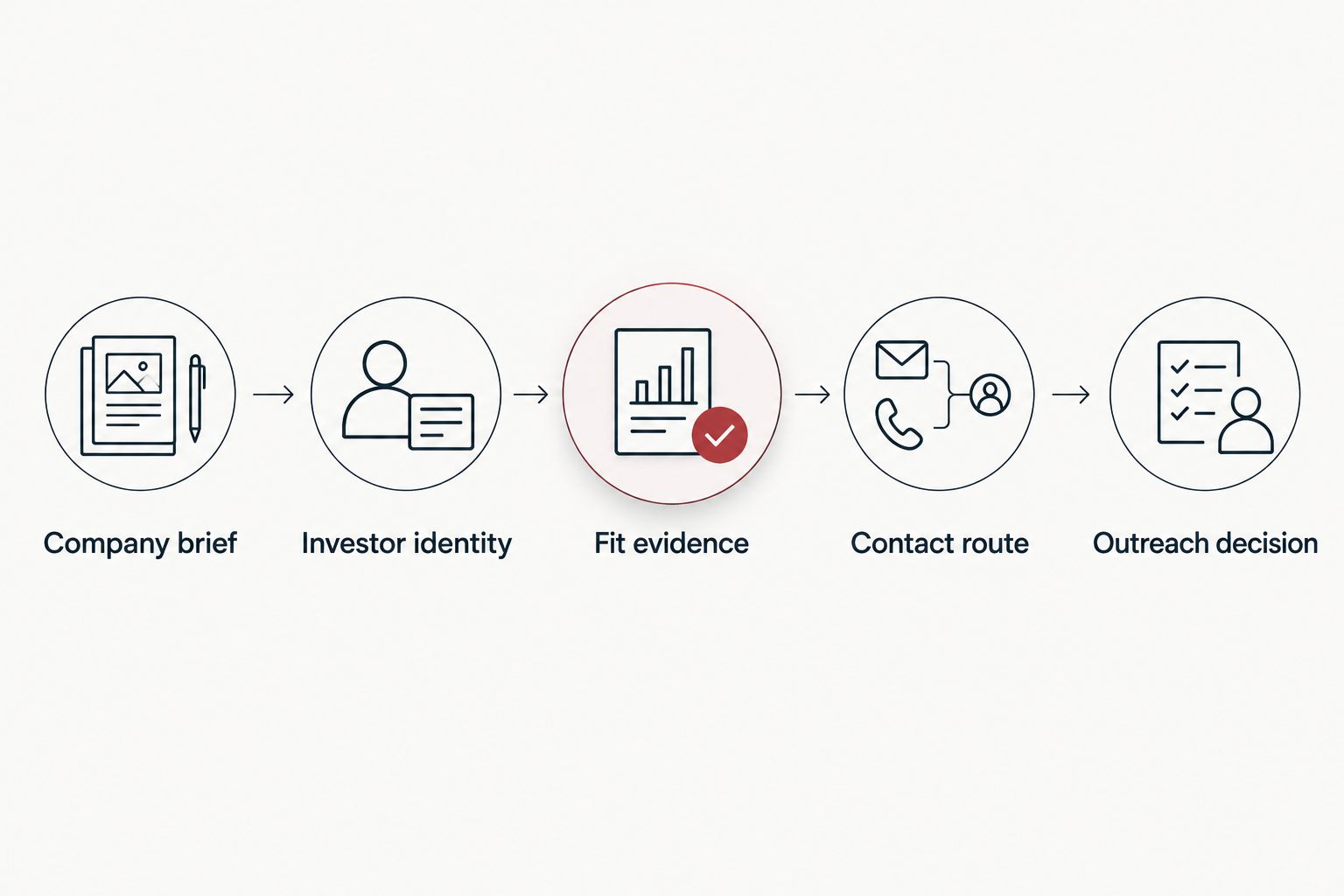
How the options are ranked
This 2026 ranking prioritizes usefulness for a pre-seed or seed founder preparing outreach. The criteria are stage fit, investor identity, fit evidence, contact route, and the verification work left to the founder.
The first option most directly matches the stated task of connecting founders with investors and reasons for fit. The remaining options serve distinct research jobs: funding history, stated investment criteria, and regional group discovery.
The ranking is a task-fit comparison, not a measured accuracy or response-rate comparison. No placement establishes that a source will produce more replies, meetings, or investment.
Which angel investor database should you choose?
For fit-led seed outreach research, start with the matching platform ranked first. Use a funding-history source when you need to investigate relevant backers. Use thesis-based discovery when you need more candidates. Use angel-group directories when the organization and its submission process matter.
For your 2026 workflow, assign each source a job. Keep discovery, verification, and outreach decisions separate. Adding another database does not resolve a weak fit reason; checking the underlying evidence does.
FAQ
What are the best angel investor databases for seed funding?
The right choice depends on the research task: use a fit-led matching platform for outreach preparation, Crunchbase for funding history, OpenVC for thesis-based discovery, and angel-group directories for regional organizations. Verify current fit before contacting any candidate.
Is Crunchbase enough to find angel investors for my seed round?
Crunchbase is useful for identifying investors through funding histories, but a historical record does not establish current angel activity or contact suitability. Verify the investor’s identity, present focus, and outreach route separately.
Is OpenVC better than a general investor database?
OpenVC is a useful choice when you want to organize discovery around investment criteria. A funding-history source serves a different job, so choose according to the question you need answered.
How do I know whether an investor is an angel or a venture fund?
Check whether the record identifies a person investing individually or an organization investing through a fund. Do not assume that a person’s professional role establishes how they make personal investments.
Can I contact every investor listed in a database?
A database listing does not establish that every investor is an appropriate outreach recipient. Confirm relevance, check the intended contact route, and follow any published submission instructions.
Does an investor match mean the investor wants to invest?
No. A match is a research starting point, not a promise of a reply or investment. Assess the fit reason and verify current interest before treating the candidate as outreach-ready.
What should I check before using an investor list in 2026?
Check investor identity, stage and sector fit, the date of supporting evidence, and the appropriate contact route. Keep unresolved questions visible instead of treating an incomplete record as a qualified prospect.
One last thing
Before sending, remove the investor’s name from your opening sentence. If that sentence could address anyone on the list, it does not yet explain the fit.
Replace generic praise with a supported connection: a relevant investment, a stated focus, or another verified reason to reach out. If no specific connection survives verification, hold the message. A contact detail is a route, not a reason.