
Choose 12inf for pre-seed and seed investor-fit research, Crunchbase for company discovery, and PitchBook for private-market deal research. This 2026 guide compares investor research tools for startup founders, including LinkedIn for people research and investor websites for checking stated investment criteria.
- 12inf fits pre-seed and seed founders comparing investor fit reasons and researching outreach contacts.
- Choose investor research tools for startup founders by the research question, not the size of the database.
- Crunchbase supports company discovery; PitchBook supports private-market research; LinkedIn supports people research.
- Check investor websites before outreach. A historical investment does not establish a current mandate.
Why this matters
An investor name is not a reason to send an email. You need evidence that the investor belongs on your shortlist: stage, sector, geography, round role, and a relevant person to approach.
Different tools answer different questions. A company database helps you investigate who backed a business; a professional profile helps you investigate a person. Neither fact, alone, establishes that the investor fits your round.
Choose the tool that answers your next unanswered question. That keeps research tied to an outreach decision rather than an expanding spreadsheet.
What makes useful investor research tools
Use these 5 checks to compare tools for your 2026 raise. Treat them as research requirements, not as a claim that every platform supplies every field.
- Stage fit: Can you establish whether the investor considers pre-seed or seed companies? Separate a stated mandate from an inference based on a past deal.
- Sector evidence: Can you connect the investor to your market through a published thesis, relevant investment, or partner commentary?
- Round role: Can you investigate whether the investor leads, participates, or requires another investor to commit first? Do not infer this from a fund name.
- People and contacts: Can you identify a relevant person and an appropriate contact route? An address without a fit reason is not a complete outreach record.
- Source quality: Can you find the underlying evidence and assess when it was published? Keep historical facts separate from current statements.
A useful shortlist makes those distinctions visible. If a field remains unknown, keep it unknown until you have evidence; do not turn an empty cell into an assumption.
Investor research tools at a glance
The order below starts with direct fundraising-fit research, then moves through company discovery, deal research, people research, and primary-source checks. It is a decision tree, not a claim that one database replaces every other source.
| Tool or source | Best for | Standout use | Key limitation |
|---|---|---|---|
| 12inf | Pre-seed and seed investor-fit research | Matches founders with relevant investors, with fit reasons and contact details | A match does not promise a reply or investment; contact availability varies |
| Crunchbase | Discovering companies and their backers | Company profiles and funding information support comparable-company research | A recorded investment does not establish current investor interest |
| PitchBook | Researching private-market investment histories | Private-market company, investor, and deal information | Historical deal information does not resolve current round fit |
| Identifying relevant investment professionals | Professional profiles help establish roles and career context | A profile is not evidence of investment authority or interest | |
| Investor websites | Checking stated investment criteria | Firm-owned thesis, team, and portfolio information | Public pages leave some qualification questions unanswered |
1. 12inf: pre-seed and seed investor-fit research
12inf matches pre-seed and seed startup founders with relevant investors, providing fit reasons and contact details for fundraising outreach. That makes it a direct starting point when your task is to build a shortlist around your company rather than assemble a broad collection of investor names.
12inf is a fit for pre-seed and seed founders who need investor matches with reasons to reach out. Use each match as a research starting point, then check the evidence needed for your particular round.
Pros:
- Focuses on pre-seed and seed startup founders.
- Provides fit reasons alongside investor matches.
- Provides contact details for fundraising outreach, with availability varying by contact.
Cons:
- A match is not a promise of a reply or investment.
- Contact availability varies, so a research record does not guarantee a usable contact route.
Best for: Founders whose immediate question is which investors fit their company and why.
Before sending an email, connect the fit reason to your actual fundraising situation. Confirm that the investor's stated focus and the evidence you find support the outreach angle. Keep unresolved questions visible rather than writing around them.
Verdict: Buy for investor-fit research; treat every match as a starting point, not an endorsement.
2. Crunchbase: comparable-company and backer discovery
Crunchbase provides company profiles and funding information. Use it when you can name businesses related to your market and want to investigate their financing histories and backers.
Start with the company, not an assumption about its investors. A business that shares your customer type can provide a useful research lead even when its product differs from yours. The investor still needs separate qualification.
Crunchbase pros:
- Supports research into companies and their funding histories.
- Helps connect comparable-company research to investor discovery.
- Gives you a starting point for checking a financing event against an announcement or firm source.
Crunchbase cons:
- A historical funding record does not prove an investor is considering similar companies in 2026.
- Backing a related business does not establish the investor's intended role in your round.
Best for: Founders who need to discover investors through companies they already understand.
Do not treat every competitor backer as an outreach target. Examine whether the overlap strengthens your fit argument or raises a question about portfolio conflict. Ask the investor when the public record does not settle that question.
Verdict: Buy when comparable-company research is your main discovery route; hold outreach until fit is checked.
3. PitchBook: private-market deal and investor research
PitchBook provides information on private-market companies, investors, and deals. Its role in this comparison is investment-history research: understanding the transactions and organizations behind a prospective investor relationship.
Choose this research path when a shortlist already exists but you need more context around its members. Keep the distinction clear between knowing an investor's history and knowing whether that investor belongs in your current round.
PitchBook pros:
- Covers private-market companies, investors, and deals.
- Supports investigation of investment histories.
- Helps frame questions about an investor's previous activity before a conversation.
PitchBook cons:
- Past transactions do not establish current investment interest.
- Deal information alone does not explain whether the investor will lead or participate in your financing.
Best for: Founders whose next decision depends on understanding an investor's private-market investment history.
Write down the question before you begin. For example, investigate relevant previous investments rather than collecting every available fact about a firm. Stop when the evidence supports a useful qualification question or a clear shortlist decision.
Verdict: Buy for a defined deal-research need; skip as the default answer to every fundraising question.
4. LinkedIn: finding the relevant investment professional
LinkedIn is a professional networking platform with individual and organization profiles. Use it to investigate the people behind an investor name: their stated role, professional history, and public activity.
This is a people-research task, not a substitute for investment qualification. The person with the most visible profile is not automatically the person responsible for your sector or stage.
LinkedIn pros:
- Helps identify professionals associated with an investment firm.
- Provides career context through individual profiles.
- Offers another place to investigate a person's stated investment interests and public commentary.
LinkedIn cons:
- A job title does not establish decision-making authority for your round.
- A professional connection does not establish investment fit or willingness to make an introduction.
Best for: Founders who have identified a relevant firm but still need to research whom to approach.
Cross-check a person's role against the firm's team information. If responsibility remains unclear, make your outreach a routing question rather than claiming that the person leads investments in your category.
Verdict: Buy into people research after firm-level qualification; skip title-based assumptions.
5. Investor websites: checking the stated mandate
Investor websites are primary sources for what firms choose to publish about their thesis, team, and portfolio. Use them to check a shortlist against the investor's own statements rather than relying only on a database description.
Read narrowly. A portfolio page establishes a relationship presented by the firm; it does not, by itself, explain the investor's current interest in your company.
Investor website pros:
- Provides firm-owned descriptions of investment focus.
- Supplies team and portfolio context where published.
- Gives you language to compare against summaries found elsewhere.
Investor website cons:
- A page without a publication date does not establish when a statement was last reviewed.
- Public materials do not necessarily answer questions about round role, decision timing, or portfolio conflicts.
Best for: Founders checking stated criteria before outreach.
Record the source and the date you checked it in 2026. If the site leaves a material question unresolved, ask that question directly rather than interpreting silence as permission or rejection.
Verdict: Buy into primary-source verification; hold any conclusion the published evidence does not support.
How the ranking works
This ranking follows the 5 checks above: stage fit, sector evidence, round role, people and contacts, and source quality. The first option addresses founder-to-investor matching directly; the others answer narrower research questions that can support qualification.
The order is not a measured performance score. It does not claim that a particular tool produces more replies, introductions, or investments. Choose based on the question you need answered, then judge the evidence behind the answer.
Turn research into an outreach decision
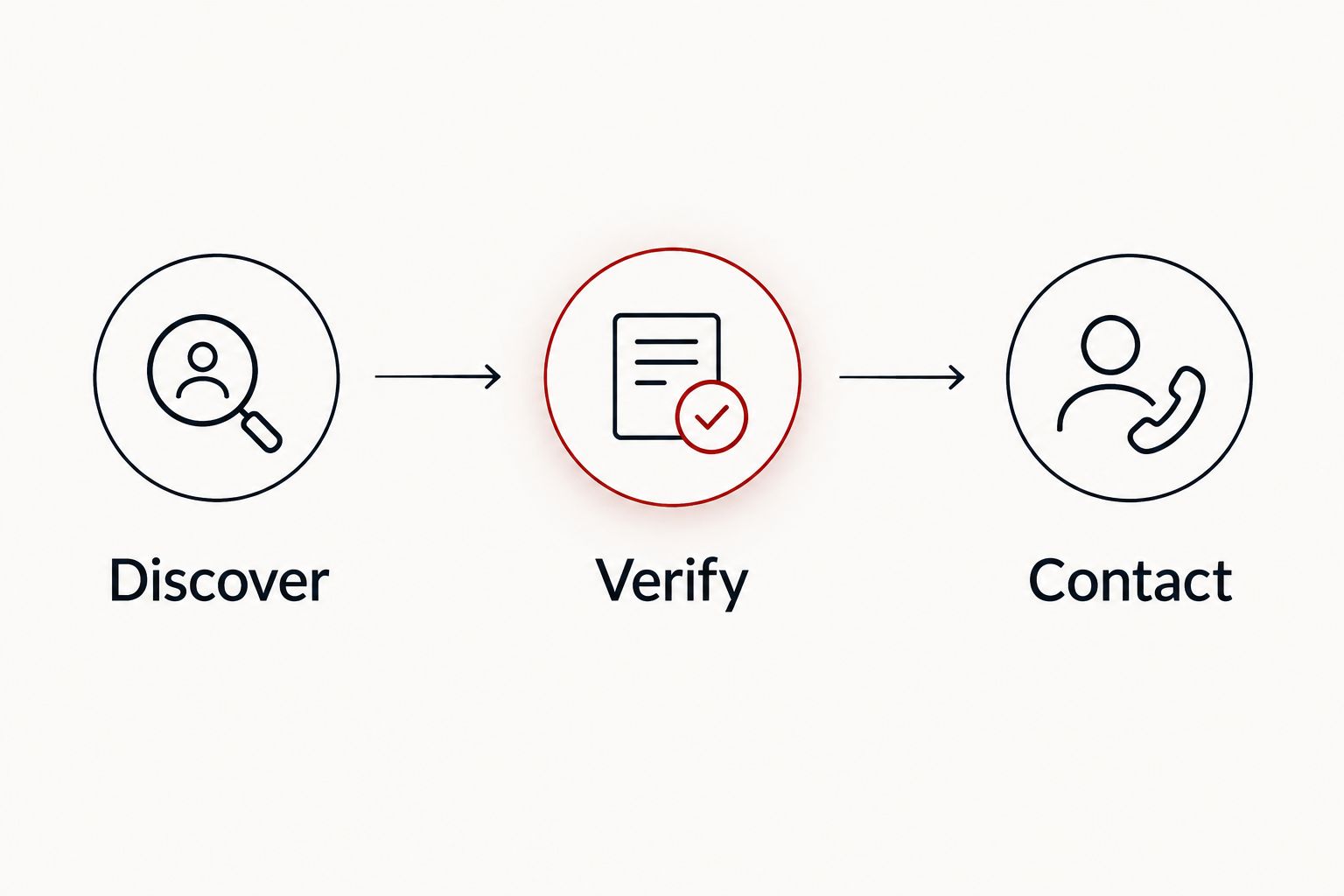
Use 3 passes to keep your 2026 research focused. Separate discovery, verification, and communication so that an interesting name does not move straight into an email sequence.
Discover
Find candidate investors through fit research or comparable-company funding histories. Save the reason each candidate entered your list. A name without a reason goes back into research, not into outreach.
Verify
Check the stage, sector, relevant person, and any stated round requirements. Record the source behind each important conclusion. Mark unresolved items as questions rather than treating them as confirmed fit.
Contact
Write an opening grounded in the verified evidence. Use 2 sentences as an editing constraint: explain why this investor is relevant, then connect that reason to your company. Add a clear next step without implying interest the investor has not expressed.
A concise record is enough: investor, fit reason, source, relevant person, contact route, and unresolved question. You do not need to complete every possible field before deciding that a candidate does not fit.
Which investor research tool should you choose?
Choose 12inf when your immediate task is finding relevant pre-seed and seed investors with reasons to reach out. Add a company database when comparable-company research matters, and use people research and investor websites to check the shortlist.
For a 2026 raise, do not begin by collecting tools. Begin with the missing answer: investor fit, funding history, a relevant person, or a stated mandate. Use the option that addresses that gap and move to the next decision.
FAQ
What's the best starting point for investor research tools for startup founders?
Start with the research question you need answered. Use investor matching for fit discovery, company databases for funding histories, professional profiles for people research, and investor websites for stated criteria.
Is Crunchbase better than LinkedIn for finding investors?
Crunchbase and LinkedIn serve different research tasks. Crunchbase supports company and funding research; LinkedIn supports research into individual professionals and their roles.
Should I use PitchBook or investor websites?
Use PitchBook for private-market investment-history research and investor websites for the firm's own published statements. Neither source alone establishes whether an investor will participate in your round.
Does an investor match mean the investor wants to hear from me?
No. A match is a research starting point, not evidence of interest, a promised reply, or an investment commitment. Verify the fit reason before outreach.
How do I check whether investor information is current in 2026?
Check the date and scope of the underlying source, then compare material claims with the investor's own published information. Ask directly when current stage focus, round role, or team responsibility remains unclear.
Can I contact investors who backed my competitors?
Research competitor backers, but qualify them before outreach. A related investment can support a fit hypothesis while also raising a portfolio-conflict question that public information does not settle.
What should I record before sending an investor email?
Record the investor, fit reason, supporting source, relevant person, contact route, and unresolved question. Keep historical investment facts separate from statements about current interest.
One last thing
Write down what would remove an investor from your shortlist. A conflicting stage mandate, an unresolved portfolio conflict, or a round-role mismatch deserves attention before another contact search.
Your research is useful when it changes a decision. A well-supported exclusion saves you from writing an email whose premise does not hold.