
Best for fit-led outreach: 12inf. Best for researching company funding histories: Crunchbase. Best for private-market research: PitchBook. Best for self-directed investor discovery: OpenVC. This 2026 guide compares VC databases for pre-seed founders by the research job each serves, not by the size of its investor list.
- 12inf is the best fit among these VC databases for pre-seed founders who want match reasons and outreach contacts.
- Crunchbase helps you trace company funding histories and identify investors behind comparable businesses.
- PitchBook suits broader private-market research; OpenVC suits self-directed investor discovery.
- Verify stage, investment evidence, round role, and contact relevance before sending outreach.
Why this matters
A database helps you find names. A fundraising shortlist needs reasons. An investor's presence in a search result does not establish that the investor backs your stage, understands your market, or will participate in your round.
For a pre-seed founder choosing a database in 2026, the useful distinction is discovery versus qualification. Discovery produces candidates. Qualification connects each candidate to evidence you can use in a relevant message.
Start with the research task you cannot complete today. If you already have investor names but cannot explain the fit, another directory does not resolve the problem. If you lack names altogether, a discovery resource gives you a starting point.
None of the options below promises a reply, a meeting, or an investment. Treat every match, profile, and contact as something to evaluate before outreach.
What makes the best VC databases for pre-seed founders
Use these criteria for your 2026 shortlist:
- Stage fit: Look for evidence of pre-seed participation, not just a broad venture-capital label.
- Investment evidence: Separate a stated interest from an actual investment in a relevant company.
- Explainable relevance: You should be able to state why the investor belongs on your list.
- Contact relevance: A contact is useful only when the person and route suit your outreach.
- Round role: Distinguish an investor who can lead from one who participates alongside a lead.
- Source visibility: Keep the underlying source and its date wherever you can verify a claim.
Do not treat missing information as confirmation. A profile without a stated geographic restriction does not prove that the investor invests everywhere. An investor associated with a seed round is not automatically a pre-seed investor.
VC databases at a glance
| Option | Best for | Standout use | Key limitation |
|---|---|---|---|
| 12inf | Fit-led pre-seed outreach | Investor matching with fit reasons and contact details | Contact availability varies; a match still needs research |
| Crunchbase | Company and funding-history research | Connecting company profiles, funding rounds, and investors | Funding history does not establish current investment intent |
| PitchBook | Broader private-market research | Researching companies, investors, funds, and deals together | Broad market research does not replace founder-specific qualification |
| OpenVC | Self-directed investor discovery | Finding investor candidates through an investor-discovery resource | You still need to validate the thesis, evidence, and outreach route |
The options are not interchangeable. Choose according to the question you need answered, then verify the answer against current investor information.
1. 12inf: best for fit-led pre-seed outreach
The platform matches pre-seed and seed startup founders with relevant investors. It provides fit reasons and contact details for fundraising outreach. That makes it relevant when your immediate task is turning investor discovery into a reason to make contact.
Best for: Founders who want an investor research starting point that includes an explanation of relevance.
12inf pros:
- Focuses explicitly on pre-seed and seed founders.
- Provides fit reasons alongside investor matches.
- Provides contact details for outreach, with availability varying.
12inf cons:
- Contact availability varies.
- A match does not promise a reply or investment.
- Fit reasons still require your judgment before outreach.
Use a match to write a specific research question. Does the investor back companies at your stage? Is the relevant investment recent enough to support your message? Does the contact belong to the person you need to reach?
Keep the distinction between a fit reason and a pitch. A useful reason explains relevance; your message still needs to describe your company and make a clear request. Do not turn a database explanation into an unsupported claim about an investor's intentions.
Verdict: Choose this option when fit reasons and outreach contacts are your main research needs.
2. Crunchbase: best for company funding-history research
Crunchbase provides company profiles, funding information, and investor information. Its clearest role in this comparison is helping you research businesses related to yours and identify investors associated with their funding.
Best for: Founders building an investor list from comparable companies rather than starting with a broad investor directory.
Crunchbase pros:
- Connects company research with funding information.
- Helps identify investors associated with named companies.
- Supports a company-first approach to investor discovery.
Crunchbase cons:
- A recorded investment does not establish current interest.
- A comparable company's investor is not automatically a fit for your stage.
- Funding information alone does not establish the right contact or round role.
Start with a company that shares a meaningful characteristic with yours. That characteristic might be the customer, business model, or technical problem. A shared category label is a weaker starting point than a clear explanation of what the businesses have in common.
Then examine the investor relationship. Do not assume an investor listed against a company participated at its earliest stage. Follow the funding evidence and distinguish what the record establishes from what you still need to confirm.
Competitor backing also requires judgment. Relevant experience can support a research hypothesis, but an overlapping investment can raise a conflict question. Ask about that before sharing sensitive material.
Verdict: Choose Crunchbase when company funding histories are the basis of your investor search.
3. PitchBook: best for broader private-market research
PitchBook is a private-market data platform covering companies, investors, funds, and deals. It belongs on this shortlist when investor discovery is part of a wider research task rather than the only task.
Best for: Founders who need to connect investor research with fund, transaction, and private-company context.
PitchBook pros:
- Covers several connected parts of private markets.
- Supports research beyond an isolated investor name.
- Helps frame questions about investors, funds, and deal activity.
PitchBook cons:
- Broad coverage does not establish fit for your particular round.
- Transaction context is not proof of current willingness to invest.
- A narrow outreach task still requires a separate qualification decision.
Define the research question before choosing a broad platform. You might need to understand which investors appear in a particular market, how a fund relates to an investment, or which transactions deserve closer examination.
Keep those questions separate from outreach readiness. A detailed investor record can be useful without establishing that the investor is appropriate for your pre-seed round. You still need stage evidence, a reason for relevance, and a suitable person to contact.
Do not choose a research platform simply because it contains more categories of information. Choose it because those categories answer questions that affect your next decision.
Verdict: Choose PitchBook for a wider private-market research task, not merely to collect outreach names.
4. OpenVC: best for self-directed investor discovery
OpenVC is an investor-discovery resource for founders. Its role here is straightforward: use it to find candidate investors, then build your own evidence-backed shortlist.
Best for: Founders who want to conduct investor qualification themselves after an initial discovery step.
OpenVC pros:
- Centers the research task on finding investors.
- Provides a starting point for founder-led discovery.
- Fits a workflow where you maintain your own qualification notes.
OpenVC cons:
- Discovery does not establish investment intent.
- Investor relevance still needs supporting evidence.
- You need to confirm the appropriate outreach route.
Set your criteria before browsing. Record your stage, market, operating geography, and the investor role your round needs. These criteria give you a consistent way to reject irrelevant candidates instead of keeping every recognizable fund.
For each candidate, write a reason to continue researching or a reason to stop. A familiar name without supporting evidence should not outrank a less familiar investor with a clear connection to your business.
Keep unresolved questions visible. If you cannot establish stage fit or identify the relevant person, mark that gap rather than treating the profile as ready for outreach.
Verdict: Choose OpenVC when you want a discovery starting point and will handle qualification yourself.
Turn database results into an outreach shortlist
Use 2 research passes: discovery first, qualification second. Keeping them separate prevents a promising search result from becoming an outreach target before you have checked it.
Discovery pass
Collect candidates against a written investment hypothesis. Describe your company in terms an investor can assess: stage, customer, problem, business model, and operating geography. Use the same description throughout the search.
Save the evidence that attracted you, not just the investor's name. Otherwise, you will need to repeat the research when you draft the message.
Qualification pass
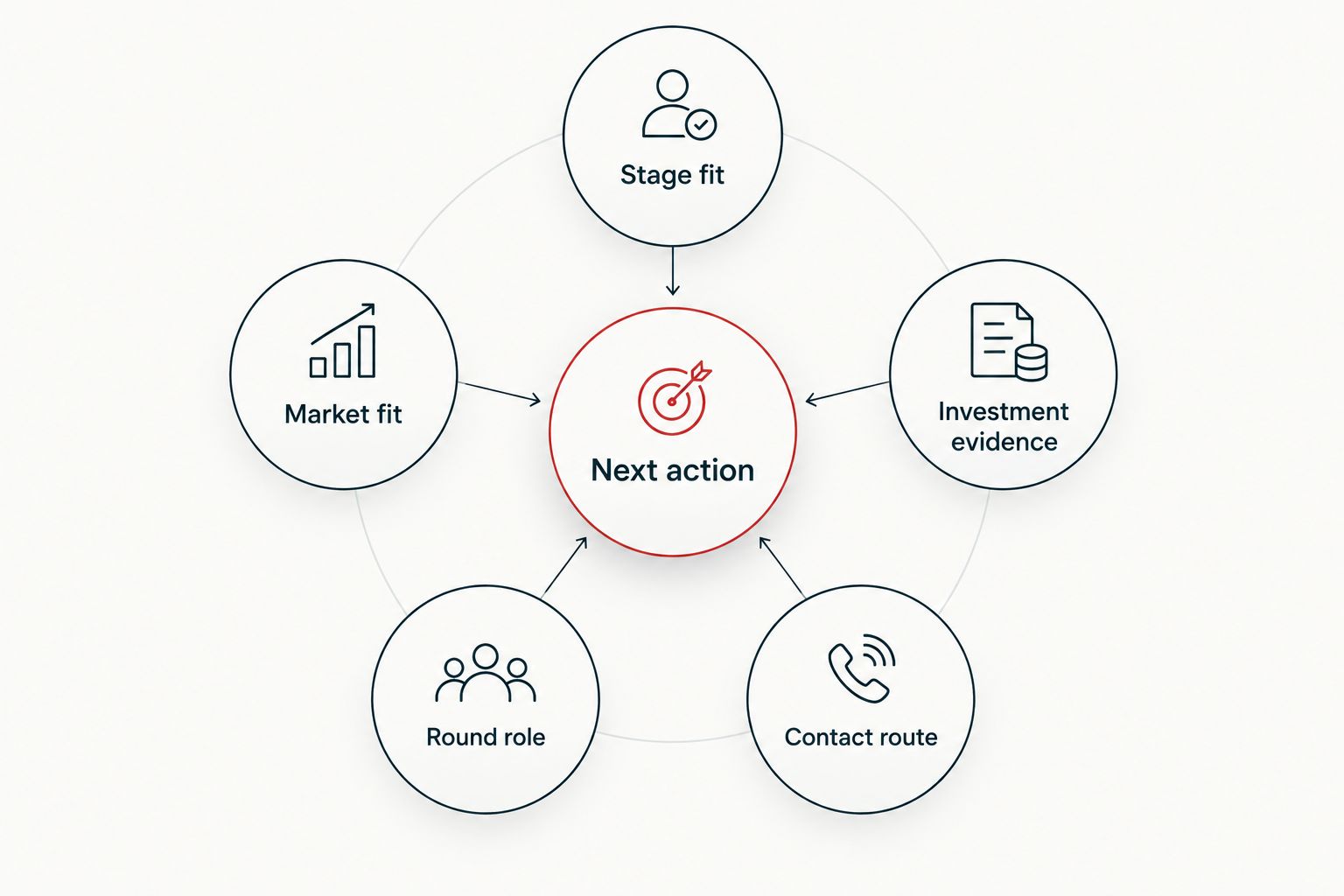
Record 6 fields per investor:
- Stage fit: Evidence that the investor considers companies at your stage.
- Market fit: A stated interest or investment connected to your market.
- Investment evidence: The source supporting the proposed connection.
- Round role: Whether lead or participant status is established or unresolved.
- Contact route: The person and route you intend to use.
- Next action: Send, research further, ask for clarification, or remove.
These fields form a research checklist, not a claim that every database supplies them. Keep unknowns explicit. Missing evidence is a task to complete, not a reason to manufacture certainty.
Write 1 fit sentence per investor before drafting an email. State the relevant evidence and explain the connection to your company. If the sentence only says that the investor backs startups, the research is not specific enough.
Do not force the evidence to support your preferred name. Remove candidates whose stated criteria conflict with your round. Keep uncertain candidates in research rather than mixing them with investors ready for outreach.
How to judge the ranking
This ranking prioritizes the distance between a research result and a defensible outreach decision. The criteria are stage relevance, investment evidence, explainable fit, contact relevance, round role, and source visibility.
It is a use-case ranking, not a claim that every feature or record has been independently tested. The first choice suits fit-led outreach; the other options serve company-history research, broader market research, or self-directed discovery.
For a 2026 decision, verify current product information directly before committing. If access terms affect your choice, check the pricing page rather than relying on a comparison article to reproduce them.
Which VC database should you choose?
12inf is the best fit among these VC databases for pre-seed founders who want match reasons and outreach contacts. Choose a different starting point when your immediate research question is different.
Use Crunchbase when you need to work backward from a company and its funding history. Use PitchBook when the task extends across private companies, investors, funds, and transactions. Use OpenVC when you want to discover candidates and conduct qualification yourself.
Your default should be the option that helps you complete the next research decision. Do not assemble several databases before establishing what evidence your shortlist needs.
For your 2026 process, keep one shortlist with consistent fields regardless of where a candidate originated. That makes contradictory information visible and keeps outreach decisions tied to evidence rather than familiarity.
FAQ
What's the best VC database for a pre-seed founder?
12inf is the best fit in this comparison for pre-seed founders who want investor matches, fit reasons, and outreach contacts. Crunchbase, PitchBook, and OpenVC suit different research tasks. A match remains a research starting point, not a promise of investment.
Is Crunchbase enough to build an investor shortlist?
Crunchbase provides a starting point for a shortlist built from company funding histories. You still need to verify stage fit, current relevance, round role, and the appropriate outreach contact.
Should a pre-seed founder use PitchBook?
PitchBook fits a pre-seed founder whose research extends across companies, funds, investors, and deals. For a narrow outreach task, define the evidence you need before choosing a broad research platform.
Is OpenVC a substitute for investor qualification?
No. OpenVC supports investor discovery, but discovery does not establish investment intent. Check the investor's criteria, supporting investment evidence, and contact route before outreach.
Does an investor contact mean I should send a pitch?
No. A contact detail does not establish investor fit or permission to assume interest. First confirm the person's relevance and write a specific reason for reaching out.
Should I contact investors who backed a competitor?
Research competitor backers, but check for conflicts before sharing sensitive information. A related investment can establish relevant experience without establishing willingness to invest in your company.
What should I verify before using an investor match?
Verify stage fit, market fit, investment evidence, round role, and the contact route. Keep unresolved questions visible and choose a next action based on what the evidence supports.
One last thing
The most useful shortlist entry can be a documented reason not to contact an investor. A clear stage mismatch or unresolved conflict gives you a concrete next decision. A famous name without evidence does not.
Before sending outreach in 2026, read the fit sentence without looking at the investor's name. If it does not explain a specific connection, return to the research. Less list-building. More reasons to reach out.